

The Accessible Soils And Sustainable Environments (ASASE) project, implemented by ETG | Beyond Beans and funded by The Netherlands Enterprise Agency (RVO), aims to address the pressing issues facing cocoa farming in Ghana, particularly the adverse effects of deforestation and climate change.
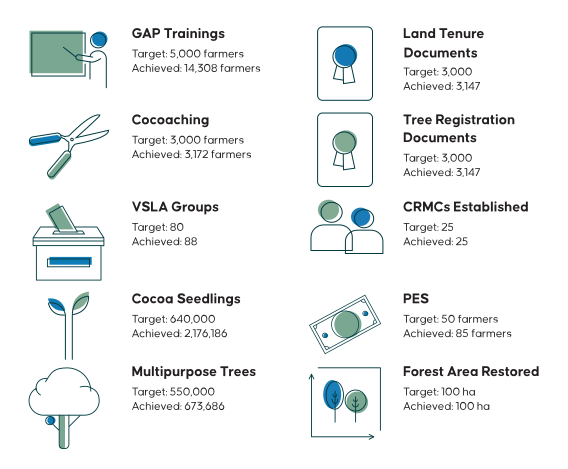
With over 865,000 households dependent on cocoa farming in Ghana, the project focuses on implementing six interventions both on and off cocoa farms to build resilience and promote sustainable practices. Activities include land titling and shade tree registration for 3,000 farmers, distribution and planting of more than 600,000 multipurpose tree seedlings for on- and off-farm planting, and the reforestation of degraded lands such as illegal ‘galamsey’ gold mining sites.
Individual Farmer Coaching
ASASE provides individualised coaching to farmers through our field officers, aiming to build trusting relationships and increase adoption rates of Good Agricultural Practices (GAP). With a focus on climate agroforestry, this coaching program aims to enhance farmers’ resilience to climate change. Over 1 million cocoa seedlings and 318,092 shade tree seedlings have been distributed, and over 14,000 farmers (5,527 women) have been trained in GAP and climate-smart cocoa farming practices. Obed, a cocoa farmer from Konongo District in central Ghana, has received training in Climate Smart Cocoa and individual coaching under the ASASE project, “In the past I cut down most of the shade trees on my cocoa plots,” he says, “but after the training I received, I realised how valuable they are and now I’m planting more with the support of the project.”

Land Titling
We partner with Meridia to secure farmers’ land rights through land titling. This initiative aims to provide farmers with long-term security over their land, enabling them to invest more confidently. By utilising GPS mapping technology and collaborating with governmental and customary authorities, we provide farmers with recognised land tenure documentation at affordable rates. Obed also received support to register his land and trees and will soon receive his land and tree registration titles. With tenure security, he can plan for the long term and make investments in his farm without fear of losing everything.

Shade Tree Registration
Recognising the importance of shade trees in cocoa farming, we also collaborate with Meridia and Tropenbos Ghana to map and register shade trees on farmers’ land. This helps farmers gain legal ownership over these trees, protecting them from exploitation by timber contractors and contributing to the preservation of cocoa plantations.
Forest Conservation
We are establishing Community Resource Management Committeesin forest-fringe communities to take the lead on conservation and reforestation efforts. These committees, comprising democratically elected members, collaborate with local authorities and the Ghanaian Forestry Commission to support forest conservation initiatives.
Reforestation of Degraded Lands
ASASE engages communities in reforestation efforts by establishing community nurseries and utilising approaches such as Payment for Ecosystem Services (PES). This initiative aims to grow multipurpose tree seedlings for distribution and planting across degraded lands, contributing to the restoration of 100 hectares of land across 25 communities.
VSLA-CHILD
So far, 88 Village Savings and Loan Associations (VSLAs) have been established under the project, with 2,253 members, including 1,305 women. VSLAs are community-based groups that collectively save a small portion of their incomes. These savings provide access to small loans that members can use to invest in their farms and side businesses, leading to diversified income and greater financial capacity. With the VSLA-Child Household Intervention for Learning and Development (VSLA-CHILD), we also integrate group training on women’s empowerment, shared household decision-making, and child protection to facilitate grassroots changes towards greater social equality.

Together, these six elements create a model to support farmer households and farmers like Obed with training, land tenure and diversified incomes. Through the ASASE project we aim for a bottom-up approach which alleviates poverty, tackles the effects of climate change, and ensures that cocoa becomes a crop that benefits rather than harms the environment.
Key Results:
Partners:
